Wednesday, August 29, 2012

Request for assistance in determining distribution of new invasive plant found in Lake Vermilion


Nelumbo nucifera (sacred or Indian lotus) has been found covering a substantial portion of Lake Vermilion in Danville, IL (just east of Champaign).  The recently discovered population is most likely an aquatic garden escapee.  IDNR is trying to determine if this is an isolated population or if other populations of this species exist in the state. If you know of a population in Illinois please contact Cathy McGlynn, Coordinator of the Northeast Illinois Invasive Plant Partnership at cathy.mcglynn@niipp.net.  

This species can be easily distinguished from our native American lotus.  Native lotus have yellow petals and nearly round seeds, while the exotic lotus has pink or white petals with seeds that are oblong.


Indiana bans sale of aquatic invasive plants

Good work out of Indiana.  This new legislation bans the sale, trade, or distribution of 28 proven invaders of aquatic systems.

Here is an article on the subject:  http://www.journalgazette.net/article/20120828/BLOGS21/120829552

Here is the actual bill:  http://www.in.gov/legislative/iac/20120411-IR-312120050PRA.xml.pdf

Tuesday, August 28, 2012

Forest Health Workshops offered throughout the state

The Morton Arboretum and Illinois DNR are hosting three forest health workshops on Aug 30 at Morton Arboretum in Lisle, September 6 at the Jackson County Extension in Murphysboro, and September 19 at State Fairgrounds in Springfield.


The 2012 Forest Health Workshops are designed for IDNR District Foresters, forest landowners, Walnut Council Association, Commercial Arborists, City Foresters, and green professionals.

Topics covered:

  • Field diagnostics
  • Insect and disease lifecycles
  • Non chemical & chemical management practices
  • Insect and disease updates ¡V Thousand cankers of black walnut, bur oak blight, bacterial leaf scorch, oak wilt, Dutch elm disease, Phytophthora ramorum
  • IL DNR Forest Health and Protection program
  • Community trees ¡V Asian longhorned beetle survey, municipal EAB management and Home Owner Association landscape management guides
  • EAB Management Survey Results
There will be classroom presentations, but most of the workshop will be spent outdoors. Registration to each workshop is limited to the first 50 applicants.

Registration fee will include refreshments, lunch, and workshop supplies Roughly 5 CEUs will be available for ISA Certified Arborists. The workshop itineraries will be made available soon.

Registration can be paid by credit card through The Morton Arboretum Registrar (630) 719-2468 to register, Monday-Friday 8:30-4:00.

Questions? Contact:

Fredric Miller, Ph.D.
Phone (815) 280-2740
E-mail: fmiller@jjc.edu
or
Stephanie Adams, M.S.
Phone (630) 719-7946
E-mail: sadams@mortonarb.org

Tuesday, August 21, 2012

The Hunt for Invasive Species Slogans - 3rd Edition - Alliteration

We are developing a series of posts to highlight some of the more memorable and fun slogans on invasive species that you can find on publications, bumper stickers, and t-shirts.  This series on invasive species slogans will include occasional posts covering different aspects of the topic.  These slogans seem to fit into three broad categories: Play-off, Alliteration, and Rhyming.  The first two posts dealt with Play-off and Rhyming slogans.  Here in this third post, I am going to concentrate on Alliteration.
If you know of some slogans that haven’t yet been posted in this series, please send them to rivertoriver@gmail.com.

*UPDATE:  The fourth post on this series, on Mascots, is now available HERE.

Alliteration
 For those of you unfamiliar with this term, I will cite the good folks over at Merriam-Webster.com:  "Alliteration - The repetition of usually  consonant sounds in two or more neighboring words or syllables".  Long a staple in sermons and graduation speeches, alliteration has made its way into conservation. 
In interest of full disclosure here, when I originally conceived of the idea to do a series of posts around slogans I came across three really good examples of alliteration so I naturally thought these types of slogans would be very abundant and before long I would have a ton of them.  This has proven not to be the case so I am taking a very liberal interpretation of the term here.

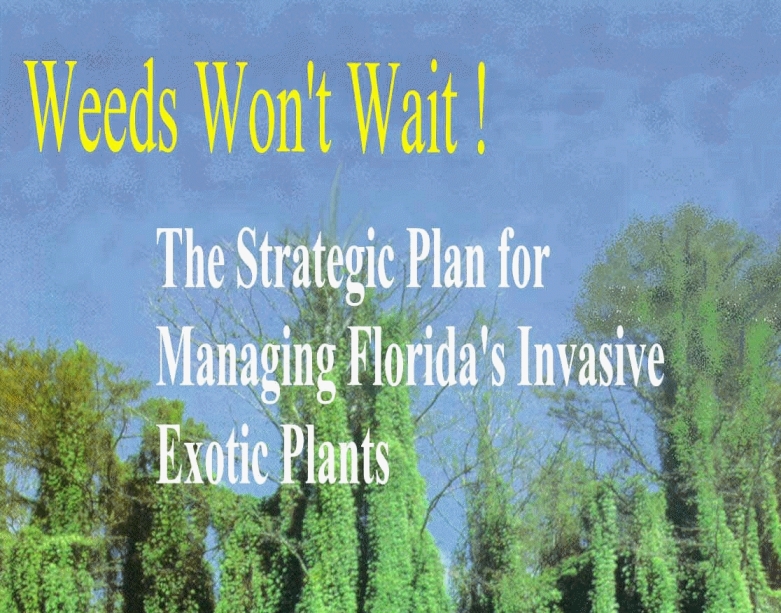
"Weeds Won't Wait"
Just one example of this famous phrase
The most famous alliteration directed towards invasive species.  If you've been working with invasive species in the United States for a while you probably instantly think of Randy Westbrooks championing Early Detection and Rapid Response when you hear this phrase.  Sometimes 'Don't Hesitate' is added in to this phrase to mix things up and add some rhyming.  Of all of the invasive species slogans out there, this one has to rank near the top.

"Fend Off Flying Fish"
h/t Kim Bogenschutz

Alliteration and personal safety!

This slogan comes to us from the Illinois/Indiana Sea Grant and is used in their Asian Carp awareness efforts.  This one is a bit unique in the invasive species world because it doesn't encourage the readers to actually work towards controlling this invasive species or even stop the spread.  Nor does it highlight the ecological damage resulting from infestation.  Instead, this slogan simply promotes taking steps to not get clobbered by a huge fish soaring through the air.  If you've ever driven a boat on a river in Illinois, you know this is an important point to get across.

"Zap the Zebra"
h/t Kim Bogenschutz
An electrifying slogan
http://www.100thmeridian.org/


No, this isn't a slogan to encourage you to taze an African mammal.  This double Z phrase comes to us from the 100th Meridian Initiative and is talking about the highly invasive Zebra Mussel.  If you are not familiar with this effort, it is one of the best examples of agenices and organizations working together on multiple levels (even international, thanks Canada!) towards meeting a common goal.  Back to the slogan, I like the way they turned the Zs into lightning bolts.  The only thing missing is a cartoon illustration of a zebra mussel getting shocked.

"Look Before You Leave"
Good advice from the Ontario Invasive Plant Council
http://www.ontarioinvasiveplants.ca/
Here is where we stray a bit from the 'traditional' definition of alliteration.  Yes, I know that this statement is a play-off of "Look before you leap" but I hadn't found this ad yet when I wrote that post.  The two main words both start with the same letter, so that is close enough to alliteration for me!  Our friends from the Ontario Invasive Plant Council placed this ad out highlighting the need to stop spreading invasive plants.  An excellent ad that is relevant to many different recreationists.  After taking a look at this ad, several thoughts came to mind: 1.  Those Canadians must be serious outdoor enthusiasts, look at all that gear!, 2.  How are they going to get that ATV loaded up in the truck with that pile of firewood in the way?, and 3. I need to plan my next vacation to go to Ontario!

"Buy It Where You Burn It"
Just one of the many ads that use this slogan.
Another one of the most well-known invasive species slogans.  Emerald Ash Borer really changed the way America approaches firewood and tree disposal.  This one is used by a lot of different groups, but Dontmovefirewood.org and emeraldashborer.info are likely the two best known groups that champion responsible firewood use.  It's amazing to me that 10 years ago nobody really thought about firewood as a threat but now pretty much anybody that camps can tell you why you need to buy it where you burn it.  To me, this is one of the greatest examples of a successful awareness campaign for conservation, right up there with the crying Indian speaking out against pollution.

"Spread the Word not the Weed"
h/t Kate Howe


www.mipn.org - I couldn't actually find a picture of this slogan
on MIPN's website, but I know they use it!
 
The last of our quasi-alliterative statements.  This slogan simultaneously promotes raising awareness and spread prevention.  A lot of beneift from a short statement!  If you attend a Midwest Invasive Plant Network conference, then you may see people running around in baby blue t-shirts with this slogan on their back.  If you do see them, be sure to compliment them on the creative slogan!


Miscellaneous Slogans

OK, now we are departing from Alliteration completely just to throw in some extra slogans that either have just been discovered or didn't really fit into any of the categories previously written about.


"Don't Move Firewood, It BUGS me"


I am definitely bugged when I see someone moving firewood!


I've only got one bumper sticker on my truck and this is it!  Like the 'Buy it where you burn it' slogan above, this one comes from www.emeraldashborer.info.  These white, magnetic bumper stickers seem to be everywhere and for a good reason. This slogan was intentionally designed to be thought provoking.  "Why would moving firewood bug someone?"  Since I've had that bumper sticker on my truck I've gotten that very question many times.  But this slogan is not restricted to bumper stickers!  It is also used on matchbooks!


A tool both for learning about invasive insects
and to start burning that unmoved firewood


"'Thistle' Ruin Your Day"


This slogan will not ruin your day!

A clever play-off slogan.  This example comes from California Invasive Species Awareness Week (California only as an Awareness WEEK?, here in Illinois we have a whole MONTH!).  This slogan get the point across while hilighting a group of serious invaders.  Well done!


This three-part series on invasive species slogans has been a ton of fun to write.  I really appreciate everyone that sent in slogans.  If your slogan or logo was not yet used, then fear not, this won't be the last of these posts.  I am already planning the next one, focused on invasive species mascots or drawings, so if you know of any graphic-based representations of invasive species or come across any more great slogans, be sure to send them to rivertoriver@gmail.com.  Also, be sure to read the rest of this series and follow the Illinois Invasive Species Awareness Month news blog at www.facebook.com/illinoisISAM.


Monday, August 6, 2012

Guest Article - Fermilab Natural Areas

Illinois is full of dedicated people and innovative ideas for addressing invasive species.  From time to time, this blog is going to host guest articles in which the stories about some of these people, projects, or ideas are told.  The next article in this series comes from Ryan Campbell from Fermilab Natural Areas.  For those of you not familiar with Fermilab, it is a research facility specializing in hihg-energy particle physics.  The scale of their huge particle accelerate, the Tevatron, means that Fermilab owns lots of land.  Much of this land is managed for natural systems and addressing invasive species is definitely a large part of that work.  This gues article focuses on these efforts.  All of the guest articles can be viewed HERE.


Fermilab Natural Areas
by Ryan Campbell


Hard-working volunteer crew
Thinking about controlling invasive, woody shrubs during the cold of winter might seem like an odd thought in the middle of summer.  But, it is somehow refreshing to imagine the frozen, snowy ground and the freshly cut stumps of buckthorn.  There is a certain magic in the winter air.  Over a thermos of coffee is when you meet newcomers and reconnect with devout brush-cutting volunteers.  We spend all winter working the edges of woodlands and clearing around witness trees with saws and loppers.  Our target invaders are buckthorn, bush honeysuckle, Japanese barberry, burning bush, autumn olive, oriental bittersweet, and European high-bush cranberry.  Every Monday afternoon we plug along; talk, laugh, work.  By the time spring arrives, we almost don’t want to quit.  The wildflowers are beautiful but there is still more to do.  Always, we are thinking, just one more buckthorn before we put the saws away.
           

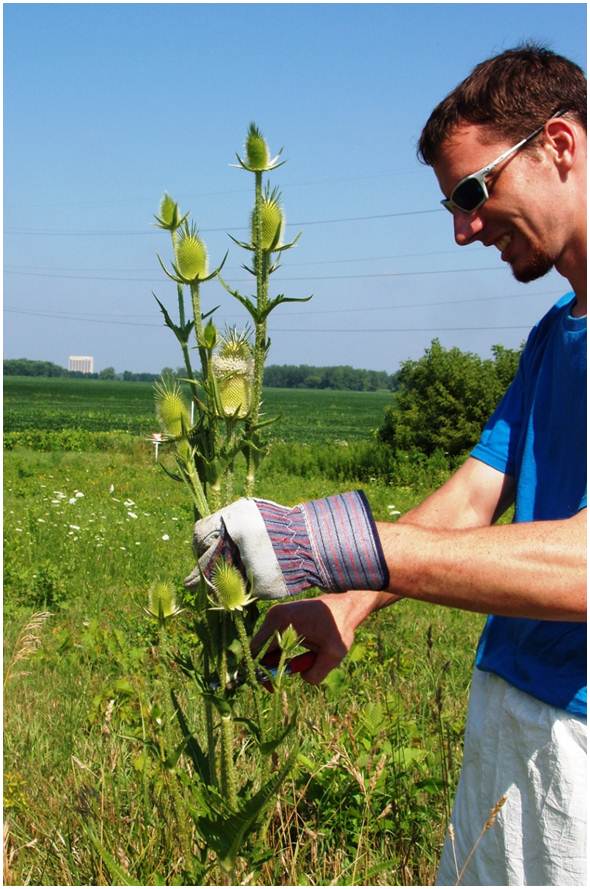
Teasel control

With spring comes summer and summer brings chaos.  Our mission is to work as diligently as possible to prevent seeds from setting on a huge number of invasive weeds.  Often these species are overlapping in life cycles.  Often they require different methods of control.  Often the weather is hot, or humid, or full of mosquitoes.  More often, it is all of those things.  We hope that our late winter prescribed fires have killed many of the garlic mustard rosettes.  If not, recruiting volunteers for hand pulling is our only option.  The leaves of reed canary grass are a foot tall before you know it.  Chemical control helps this over-achiever die back so that a wide variety of native wetland plants may thrive.  At the same time we are spraying the rosettes of poison hemlock before they bolt and grow to be 8 foot tall plants.  Wild chervil and wild parsnip are next.  The former is a new invader that we keep a tight lid on with herbicide, while the parsnip is controlled by mowing.  Fortunately, we only have small populations of Japanese knotweed and hedge parsley so control can be quick and painless for us, but deadly for them.


Ryan in a stand of Phragmites

            As the summer continues we try to manage the large populations of crown vetch, birds-foot trefoil and sweet clover that have run rampant.  We are currently fighting an uphill battle, but we hope to be in a maintenance stage within 10 years.  Selective herbicides and seasonal timing may prove successful in controlling them.  As July turns to August, we turn our sights onto several old invaders.  These however are unlike the rampant crown vetch and sweet clover.  Teasel, purple loosestrife, spotted knapweed, and Phragmites are all on an annual maintenance schedule.  They have been controlled for a number of years and the efforts show.  The hardest part is taking the time to visit each known location throughout our 6,800 acres, usually multiple times. 

           
Teasel and loosestrife being removed


Restored savanna
In September, when the seasons really start shifting dramatically to winter, we ready our tools for woody stems.  Our FECON attachment for the bobcat gets hungry for invasive shrubs.  Any oriental bittersweet we have missed now has bright orange fruits hanging like flags.  Those will be the last fruits that vine produces.  Monocultures of reed canary grass are treated chemically, making this the only species with two real seasons for control.  And when the first few frosts defoliate the vines of poison ivy, we go back into the woods with tools in our hands and smiles on our faces.  Our commitment to controlling invasive species would not be possible without the efforts of summer students, volunteers, and our Fermilab grounds crew.

Monday, July 30, 2012

New Illinois laws regarding transport of aquatic plants

Gov. Pat Quinn signed into law an amendment of the Boater Registration and Safety Act that requires aquatic plants or animals to be removed from the exteriors of seaplanes and watercraft before putting them into or transporting them away from a body of water. 

Here is a synopsis of HB3888:

Amends the Boat Registration and Safety Act. Provides that no person may place or operate a vehicle, seaplane, watercraft, or other object of any kind in waters of this State if it has any aquatic plants or aquatic animals attached to the exterior of the vehicle, seaplane, watercraft, or other object. Provides that no person may take off with a seaplane, or transport or operate a vehicle, watercraft, or other object of any kind on a highway with aquatic plants or aquatic animals attached to the exterior of the seaplane, vehicle, watercraft, or other object. Provides exceptions. Provides that a person must comply with instructions given by a law enforcement officer who has reason to believe that the person is in violation of the new provisions. Provides that the Department of Natural Resources shall produce and make copies available of a notice containing a summary of the new provisions and that owners of boat access sites must post and maintain a copy of the notice.

This is an important piece of legislation and a great first step at reducing the spread of aquatic invasive species in Illinois. 

To read the full version of the amendment, click HERE. 

Monday, July 23, 2012

Guest Article - Clifftop

Illinois is full of dedicated people and innovative ideas for addressing invasive species.  From time to time, this blog is going to host guest articles in which the stories about some of these people, projects, or ideas are told.  The next article in this series comes from Pen and Carl Daubach from the Clifftop group.  All of the guest articles can be viewed HERE.

Clifftop - Conserving Lands in Farm, Forest, Talus or Prairie
by Pen and Carl Daubach

Clifftop--Conserving Lands in Farm, Forest, Talus or Prairie--was founded in 2006 to preserve and protect Mississippi River bluff lands and wildlife habitat in Monroe, St. Clair and Randolph Counties. The goal was straightforward: work together to improve natural area conservation in the region.
            The Illinois Wildlife Action Plan (IWAP), released in 2005, framed a pretty good general blueprint for what needed to be done, and earmarked our region, the Hill Prairie and Karst Sinkhole Plain Conservation Opportunity Areas (COA), as important natural areas worthy of redoubled conservation efforts.
            The 40-mile long, 5-mile wide COA corridor contains 130,000 acres; 38,000 acres are designated Illinois Natural Area Inventory (INAI) sites, due to their ecological features and importance. The corridor is host to 48 listed threatened or endangered species. Nearly half of Illinois' remaining loess hill prairie acreage and one third of the state's remaining rare limestone glade habitats can be found in the COA. Five thousand acres in the COA are permanently protected; the state owns 2100 acres; the other acreage is privately held, but protected with conservation easements, largely registered with the Illinois Nature Preserves Commission (INPC).   
            In 2007, Clifftop facilitated bringing all the active conservation players in the COA (IDNR, INPC, NRCS, U of I Extension, HeartLands Conservancy, the Salt Lick Point Stewardship Committee, and the Friends of Stemler Nature Preserves) together and we developed our own iteration of IWAP, the Southwestern Illinois Wildlife Action Plan, to set definitive goals and lay out divisions of labor to implement IWAP. Clifftop serves as the administrative agent for the SWIWAP Partnership.
            Battling Non Native Invasive Species (NNIS) is central to the SWIWAP partnership's goals.  Bush honeysuckle and mimosa are problematic in the hill prairies; bush and Japanese honeysuckles, Tree-of-Heaven and garlic mustard, in various degrees, are well established in our upland forests and along the talus slope of our bluffs. Native, but invasive, sugar maples, particularly along shady and moister north faces, are seriously thwarting oak and hickory recruitment throughout the COA corridor’s forests.
            The SWIWAP Partnership set to work in 2008 looking for programmatic funding to incentivize private landowners to take on their invasives, and to augment IDNR efforts to tackle NNIS on state-owned lands.
            We have been very fortunate in cobbling together funds from several directions. IDNR orchestrated a large USF&WS State Wildlife Grant for hill prairie restoration work on registered reserves and preserves. In addition, IDNR reprogrammed internal funding to address NNIS on several state-owned sites. Taken together, since 2009, IDNR has committed almost $200,000 for conservation contractors to take on NNIS and to do additional prairie restoration work on about 2000 acres.
            In 2008, the Landowner Incentive Program (LIP), a USFS initiative administered by IDNR, became available as cost-share monies for private landowners in our COA. Clifftop recruited six landowners during the three-year life of the program, and $200,000 was contracted toward NNIS eradication and timber stand improvement on 450 privately held acres.
            In late 2008, in a first-ever-in-Illinois program, Clifftop and NRCS signed a Cooperative Conservation Partnership Initiative agreement to muster additional USDA Farm Bill conservation funding for the COA, through the Environmental Quality Incentive Program and Wildlife Habitat Incentive Program, to provide cost-share monies for landowners to address NNIS and conduct additional beneficial practices. To date, $600,000 for 60 landowners on 3000 acres has been contracted.
            In total, since 2009, the partnership has brought slightly over one million dollars to the COA for work on nearly 5500 acres. The lion's share of the funding has enabled work on dedicated / registered Nature Preserves, Land & Water Reserves, and INAI sites. Nearly half of those monies went to NNIS control.
            But 5500 acres is a drop in the bucket for a 130,000-acre COA. And, given the vicissitudes of federal allocations for conservation practices and the vagaries and life expectancies of the alphabet soup of federal conservation programs, the burden and responsibility for NNIS control ultimately rests with private landowners working on their own time and money.
            We developed public information and outreach programs that have gained landowner interest. A local newspaper – the Monroe County Independent -- features our monthly newspaper article series on the natural history of the corridor.  Our goal is not simply to demonize NNIS – though we regularly do that – but to also feature the benefits of a healthy landscape that retains native plants and natural biodiversity. When we do attack NNIS in print we use a 100% solution of verbal venom and offer practical advice on recognizing and controlling pest plant species. Our website reflects the same dual message: the benefits of natural native biodiversity and the role of NNIS in altering, diminishing and eliminating our native ecological systems.

"How not to kill bush honeysuckle" 
Innovative advertising (click to expand) 

            We also have instituted two hands-on practical workshops each year -- one at the Salt Lick Point Land & Water Reserve and one at Stemler Cave Woods Nature Preserve -- to show people how to identify and treat NNIS in our corridor.  Our “hook” for these annual events is a gentle tease and parody of a cherished local autumn tradition: competitive target-shooting contests called “meat shoots.” Our “Suckle Shoots” advertisements show people How Not to Kill Bush Honeysuckle, but promise attendees lessons in “tracking, spotting and killing this non-native invasive plant.”
            Our annual suckle shoots are well attended by volunteers and significant numbers of bush honeysuckle indeed “get gone” by the end of each event. An equally important side benefit also has occurred – because “the natives” enjoyed our parody of their meat shoots and laugh at the very thought of aiming gun or bow at a shrub, our digital and paper fliers get distributed into very wide circulation, increasing the reach of our message about the evils of non-native invasive plants.
            Incentivizing landowners – whether through cost-share programs or just with a laugh – continues to help Clifftop make war on non-native invasive plant species.