http://www.youtube.com/watch?
Thursday, December 27, 2012
New Video of Emerald Ash Borer - Illinois First Detector Forest Pest Program
The Illinois First Detector Forest Pest Program has a new video about Emerald Ash Borer and training dates
http://www.youtube.com/watch?
http://www.youtube.com/watch?

Wednesday, December 19, 2012
New publication available - Identification of Japanese Stiltgrass
 The River to River CWMA, along with the Alabama Cooperative Extension Service and the University of Georgia's Center for Invasive Species and Ecosystem Health has recently published a new field guide to the identification of Japanese Stiltgrass. Included in this guide are detailed descriptions and pictures of the characteristics needed for identification as well as comparisons to look-a-like species.
Hi- and low- resolution versions of this publication can be found on the Alabama Extension website at:
You can also order printed copies from Alabama Extension at:
https://store.aces.edu/ItemDetail.aspx?ProductID=17611Tuesday, December 18, 2012
New Video on Thousand Cankers Disease - First Detector Forest Pest Program
The Illinois First Detector Forest Pest Program has a new video about Thousand Cankers Disease and some new training available.
Wednesday, December 12, 2012
Job Announcement - NW IL Restoration Specialist/Invasive Strike Team
The Jo Daviess Conservation Foundation is seeking an experienced restoration specialist to join a team who will eradicate invasive plants from state parks and natural areas in Northwest Illinois.
Control strategies will include manual, mechanical, prescribed fire and chemical techniques. This 2 year position will operate out of the Lost Mound Field Station/Mississippi Palisades State Park. Please submit resumes to Jeff Horn, JDCF, PO Box 216, Elizabeth, IL 61028 or via email to jeff@jdcf.org by December 21, 2012.
__________________________
Control strategies will include manual, mechanical, prescribed fire and chemical techniques. This 2 year position will operate out of the Lost Mound Field Station/Mississippi Palisades State Park. Please submit resumes to Jeff Horn, JDCF, PO Box 216, Elizabeth, IL 61028 or via email to jeff@jdcf.org by December 21, 2012.
__________________________
Jo Daviess Conservation Foundation
This may include one or more of the following functions:
REQUIRED KNOWLEDGE AND SKILLS:
COMPLEXITY/PROBLEM SOLVING:
DISCRETION/LATITUDE/DECISION-MAKING:
COMMUNICATIONS/INTERPERSONAL CONTACTS:
WORKING CONDITIONS/PHYSICAL EFFORT:
126 N. Main St., P.O. Box 216, Elizabeth, IL 61028
815-858-9100
POSITION TITLE: Restoration Specialist– INVASIVES STRIKE TEAM
LOCATION: Lost Mound Field Station/Mississippi Palisades State Park
TERM: 2 year term
BASIC QUALIFICATIONS:
- High school diploma and 1 year’s training in science-related field or related experience in land management
- Experience recognizing plant and animal species
- Experience operating various types of equipment
- Experience performing physical work.
ESSENTIAL FUNCTIONS:
The Restoration Specialist is part of a team who will eradicate invasive, exotic plants from state parks and natural areas in Northwest Illinois. The area includes 6 counties (Jo Daviess, Carroll, Whiteside, Rock Island, Ogle, Lee) in northwest Illinois. The Restoration Specialist will implement invasive, exotic plant management control methods using integrated pest management strategies. Control strategies will include manual, mechanical, prescribed fire and chemical techniques. This position will use the Weed Information Management System, which is a Microsoft Access-based relational database application that is designed to assist natural resource managers in invasive species management. Accurate and detailed data collection is a significant part of this effort.
This may include one or more of the following functions:
- Removes exotic species using manual, mechanical, prescribed fire and chemical techniques
- Documents stewardship activities and/or monitors species using computers and handheld electronic equipment
- Assists with prescribed burns
- Maintains tools and equipment
- Assists with reporting
- Assists with research and gathering of information on invasive species
REQUIRED KNOWLEDGE AND SKILLS:
- High school diploma and 1-2 years training in science-related field or related experience in land management
- Experience working with or knowledge of natural systems. Ability to recognize plant and animal species as required to complete preserve management activities
- Ability to operate various types of equipment in a safe and efficient manner (e.g.; chainsaw, two-way radio, ATV, 4-wheel drive vehicle, brushcutter, etc)
- Ability to follow instructions from colleagues
- Ability to perform physical work, sometime under adverse conditions or in inclement weather such as carrying up to 40 lbs. up to 5 miles over steep terrain for 7 hours/day
- Willingness and ability to travel throughout northwest Illinois
- Ability and willingness to have a varying and flexible work schedule
- Ability to obtain herbicide license within 2 weeks of hire date,
- Ability to obtain proper fire certification including S130/190 and I100
- Valid driver’s license
- PC familiarity, including using a database to maintain preserve records, use of the internet, GPS experience
- Basic knowledge of GIS and using a PDA with ArcPad.
COMPLEXITY/PROBLEM SOLVING:
- May resolve preserve management problems independently as delegated.
- Consult with supervisor to develop plans for resolution of unusual or complex problems.
- Monitor the progress of work groups toward achieving preserve management goals.
DISCRETION/LATITUDE/DECISION-MAKING:
- Consults supervisor on unusual or complex issues
- Make day-to-day decisions as delegated by supervisor.
RESPONSIBILITY/OVERSIGHT – FINANCIAL AND SUPERVISORY:
- Receives detailed instructions to complete required tasks
- May work under close supervision or infrequent supervision
- Supervises no staff, but may help plan and direct preserve work groups, including other staff or volunteers.
COMMUNICATIONS/INTERPERSONAL CONTACTS:
- Ability to convey work instructions to other preserve management team members, including volunteers.
- Ability to interact with preserve visitors and to convey basic preserve information.
- Ability to function productively as a member or leader of a work team.
- Ability to communicate effectively with multiple supervisors in different locations.
WORKING CONDITIONS/PHYSICAL EFFORT:
The Restoration Specialist may work in variable weather conditions, at remote locations, on difficult and hazardous terrain, and under physically demanding circumstances. These conditions:
- require considerable physical exertion and/or muscular strain
- present frequent possibility of injury
- require long hours in isolated settings
The Jo Daviess Conservation Foundation is an Equal Opportunity Employer.
Tuesday, December 11, 2012
Saltcedar (Tamarix parviflora) found along the Mississippi River in Alton, IL, population under active management
 |
| Saltcedar infestation at Lock and Dam 26 |
The US Army Corps of Engineers (ACOE) recently found a small population of smallflower saltcedar (Tamarix parviflora) along the banks of the Mississippi River below Lock and Dam 26 near Alton, IL in July 2012. Recognizing the potential this invader has for spreading throughout the Mississippi River Valley and its ability to dominate riparian areas and exclude native species, the ACOE responded very quickly by initiating an eradication program. This represents one of the first documented infestations of saltcedar in Illinois and is a great example of Early Detection and Rapid Response for a new invader. The ACOE is dedicated to continuing management efforts with the goal of eradicating this population.
 |
| ACOE employees treating infestation |
Saltcedar does represent a great threat to riparian areas and wetlands in Illinois if populations become established and begin to spread. Luckily, saltcedar is relatively easy to recognize. On the surface, saltcedar looks like a thin, open red cedar tree, with similar leaves and growth. Trees rarely get above 15 feet in height, usually being much smaller and often multi-stemmed. The branches are very slender and wispy. Younger bark has a reddish cast. The flowers on saltcedar are very small and purple. The leaves are very reduced and scale-like, looking very much like the leaves of red cedar.
 |
| The reddish bark and reduced leaves help identify saltcedar (photo courtesy of www.bugwood.org) |
 |
| Saltcedar often grows as a small, multi-stemmed shrub. The thin, open branches and small leaves make this plant easily recognizable (photo courtesy of www.bugwood.org) |
Henry and Knox Counties Added to EAB Quarantine in Illinois
SPRINGFIELD, Ill. – The Illinois Department of Agriculture has added two new counties (Henry and Knox) to its existing 39-county emerald ash borer (EAB) quarantine.
For full report, go to the Illinois CAPS program news blog HERE.
For full report, go to the Illinois CAPS program news blog HERE.
The Hunt for Invasive Species Slogans 4th Edition - Mascots
We are developing a series of posts to highlight some of the more memorable and fun slogans on invasive species that you can find on publications, bumper stickers, and t-shirts. This series on invasive species slogans will include occasional posts covering different aspects of the topic. These slogans seem to fit into three broad categories: Play-off, Alliteration, and Rhyming. This series has proven to be very popular so we are expanding it with this post on Invasive Species Mascots.
If you know of some slogans, invasive species illustrations or mascots that haven’t yet been posted in this series, please send them to rivertoriver@gmail.com.
Mascots
Previous to this post, this series of invasive species slogans has focused more on the written aspect of slogans. Now we want to shift our lens to zoom in on some great illustrations. Mascots have long been used in advertising and marketing (think of the Pillsbury Doughboy for example). The same has been true for conservation as well (Hello Smokey the Bear!). Below are some highlights of mascots being used in invasive species outreach programs. I've added in a few "not exactly mascots' at the end because I really liked them and needed to find a way to share them with everyone.
The ‘not quite official’ State Seal of Virginia
h/t Tim Farmer
One of the best things about doing this series of invasive species slogans has been the emails and entries that I’ve received from folks across the country. This is perhaps my favorite of the bunch. I got an email from Tim Farmer down in Virginia with the official and ‘not quite official’ state seals for their great state. I’ll copy in Tim’s description here before showing you the seals
The Many Faces of Yellow Starthistle
Many of you likely know yellow starthistle as a serious invader of western rangelands. This plant is a major bad actor, but its appearance must just invite people to animate it. Over the years, I’ve ran across several different ‘versions’ of starthistle, each with their own personality.
The ‘Evil’ Starthistle
These are a couple of screen shots from a YouTube video posted by the BLM. This version of starthistle is 100% pure evil and comes equipped with death ray eyes (and I thought the spiny bracts were bad enough)! The bloodshot eyes and Bart Simpson-like hair really do round out this starthistle as being the toughest on the block. This picture also has the honor of being the only slogan in this entire series that has earned a place up on my wall.
The “Sinister” Starthistle
If you’ve followed this series of posts, then you may recognize this picture as coming from the Forest Service’s ‘Give a Hoot, Gives Weed the Boot’ campaign that was posted about earlier. This version of the starthistle would make a great villain on a Saturday morning cartoon. Extra credit goes to the illustrator for utilizing spines for angry eyebrows!
The ‘Happy’ Starthistle
This fun drawing is by Gary Raymond from a delightful book titled “Weeds on the Move” by Donna and Shawna Vaughn. While the other caricatures of this invader aim to give off negative vibes, this one goes for more of a ‘pleasant’ tone. While there is definitely nothing pleasant about an infestation of starthistle, Gary’s drawings certainly do make this book a fun read.
Murry the Squirrel
 I’ve got to admit, this one confused me quite a bit when I first looked at it. I didn’t know why Murry the Squirrel was stomping out invasive plants, but I was glad he was and was willing to help out! This comes out of Murrysville PA (hence the name Murry for our furry little plant stomper) and their Friends of Murrysville Parks. This pamphlet details information on a handful of invasive species and what can be done to manage them. Peppered throughout the trifold are pictures of Murry apparently distraught over invasives. I really love it when local organzations or agencies take invasive species seriously and are willing to let people know about it. Great work Murrysville!
Emmie the Emerald Ash Borer
h/t Jim Kirkland and Gae Morris
This great mascot was an invention of the Illinois Forest Resource Center to be used during Stewardship Week, which is a huge event to teach thousands of school children about many different aspects of stewardship and conservation (on a side note, I’ve been honored to take part in this event now for the past five years). Emmie has been partnering with mere humans to teach kids about the threat of Emerald Ash Borer and why they need to “Burn It Where You Buy It”. I remember sitting beside Emmie the Emerald Ash Borer at lunch during Stewardship Week and while yes they are very fond of Ash Trees, I can say conclusively that emerald ash borers also take a liking to BBQ sandwiches!
Vin Vasive
This is one mascot that gives me nightmares. Vin Vasive is the spokesperson (can you call a compilation of insects formed into a human shape a person?) for hungrypests.com, a USDA-APHIS website. If the USDA-APHIS was aiming to scare people into worrying about invasive pests, then they succeeded!
Commander Ben, Invasive Hunter
While not technically a ‘mascot’, Commander Ben has developed into a great champion for invasive species. His videos, interviews, and articles on his website - http://commanderben.com/, are wonderful and very entertaining. He’s been getting some much deserved attention for his efforts. Keep it up Ben! From his website, here is a cartoon of Ben from the cover of Science Weekly.
"Little MO", The New Zealand Mudsnail
This little mascot comes from a great kids’ website from the Illinois-Indiana Seagrant about Nabbing Aquatic Invaders - http://www.iiseagrant.org/NabInvader/index.html. There are so many great things on this website, it was hard to choose just one to highlight. One of my favorites was ‘Little MO’. This snail just looks like trouble. I especially like the little ‘NZ’ sticker on his shell! Please check this website out, I especially appreciated the ‘Car Talk Credits- like’ names of the officers. I think it is just great that the officer for the Gulf is named “Louie Z Anna”!
The “Not Exactly Mascots” Section
RRIP-IT-UP
h/t Teresa Grout
I know this one isn’t a mascot but I wanted to include it here. This is perhaps the best acronym I’ve ever seen. The “Rapid Response Invasive Plant Intervention Team of the UP” Or RRIP-IT-UP comes to us from the Upper Peninsula Conservation & Development Area, Inc. This response team manages a lot of garlic mustard by, you guessed it, ripping it up!
CactoBlastis or Cacto Blast Us?
h/t Joel Floyd
Here’s another great illustration that was sent to me. Joel Floyd, with USDA-APHIS, designed this for use on a T-shirt for the Cactoblastis program. If you know about this moth, it has been used as a biocontrol for invasive prickly pear in parts of the world, but has spread to the southeast United States and is attacking out native prickly pear species. Aphis has been leading the charge on the management of this insect, including coming up with great T-shirt designs.
Garlic Mustard Wine
h/t Troy Evans
Yes, you read that correctly, Garlic Mustard wine. I can think of few plants less appropriate to make wine from than Garlic Mustard. Seriously, maybe poison ivy or jimsonweed wine would be worse but it is debatable. I do however really like their slogan “Eliminating Invasive Plants one bottle at a time”. I think this bottle has remained firmly unopened for fear of what’s inside. If you’ve ever tried such a concoction, please let me know what it tasted like (and please do not offer to share it with me!). Just a quick note, if this posts gets back to the folks that actually produce this Garlic Mustard wine, my sincere apologies for disparaging your product but, honestly, you had it coming!
What was originally meant to be a 3-part series has now been expanded to at least four. This 'Mascot' edition has probably been my favorite one to make so far. I keep getting impressed with the creativity and talent on display with these slogans and illustrations and, best of all, they are all for a good cause - increasing awareness about invasive species. So, to all of you conservationists out there, I say keep up the good work and please do use your talents to bring some humor and entertainment into a field that is honestly often somewhat depressing.
Please do check out the other entries in this series on Play-off, Alliteration, and Rhyming and all of the FUN posts we've put up on this blog. I am predicting that this will not be the last post in this series, as new slogans and illustrations are being made every day. As always, if you see something that you think would be good to include, please send it to me at rivertoriver@gmail.com. To follow the Illinois ISAM news blog, 'like' us at www.facebook.com/illinoisisam.
If you know of some slogans, invasive species illustrations or mascots that haven’t yet been posted in this series, please send them to rivertoriver@gmail.com.
Mascots
Previous to this post, this series of invasive species slogans has focused more on the written aspect of slogans. Now we want to shift our lens to zoom in on some great illustrations. Mascots have long been used in advertising and marketing (think of the Pillsbury Doughboy for example). The same has been true for conservation as well (Hello Smokey the Bear!). Below are some highlights of mascots being used in invasive species outreach programs. I've added in a few "not exactly mascots' at the end because I really liked them and needed to find a way to share them with everyone.
The ‘not quite official’ State Seal of Virginia
h/t Tim Farmer
One of the best things about doing this series of invasive species slogans has been the emails and entries that I’ve received from folks across the country. This is perhaps my favorite of the bunch. I got an email from Tim Farmer down in Virginia with the official and ‘not quite official’ state seals for their great state. I’ll copy in Tim’s description here before showing you the seals
“Here at the State Arboretum of Virginia, Ailanthus is a real problem. So I modified the state seal to show the way we feel. The REAL state seal features a woman in a tunic ("Virtue") standing over a fallen tyrant, her foot on his chest. She is holding a spear in one hand and a sword in the other, with the words "Sic Semper Tyrannus" (Thus Always to Tyrants) beneath.
Our modified version has Virtue standing with her foot on a tree stump, with Ailanthus leaves on either side. She is holding a chain saw and a shovel, and the tag line reads "Sic Semper Ailanthus."
 |
| Doesn't she know you can't operate a chainsaw without the proper PPE? |
Great work Tim! Consider this a challenge to all of you other states to see if you can modify your seals to top this.
Tropical Soda Apple, the Plant from Hell
 |
| That is one devilish plant |
This is one mascot that a horror movie could be made about. That term “Plant from Hell” has been used on about 100 different invasive species, but the first time I heard it was for Tropical Soda Apple so, to me, this is the original demonic photosynthesizer. This mascot from the Florida Department of Agriculture and Consumer Services really utilizes that nickname well. From the blood-red eyes to the flames licking up around the plant, this guy does look like he’s straight out of the fiery pit.
Didymo Monster
 |
| "Noone nose better than me to snot make fun of invasive species but instead to cough up the location by reporting phlegm to the proper authorities so that they can hack them out of the system and blow away their chances to flu the coop and spread" - Anonymucus |
This cartoon is right, Didymo, aka 'rock snot', is ‘snot’ a joke! This nasty aquatic invasive algae can be a terror on streams. As a somewhat avid fly fisherman, this is one I definitely do not want spreading around. I wish I knew the original source of this cartoon, I first saw it in a presentation on Didymo at an invasive species conference in Missouri. If you know the source, please let me know (rivertoriver@gmail.com) and I’ll be sure to give proper credit.
The Many Faces of Yellow Starthistle
Many of you likely know yellow starthistle as a serious invader of western rangelands. This plant is a major bad actor, but its appearance must just invite people to animate it. Over the years, I’ve ran across several different ‘versions’ of starthistle, each with their own personality.
The ‘Evil’ Starthistle
 |
| So that's how they outcompete the natives |
These are a couple of screen shots from a YouTube video posted by the BLM. This version of starthistle is 100% pure evil and comes equipped with death ray eyes (and I thought the spiny bracts were bad enough)! The bloodshot eyes and Bart Simpson-like hair really do round out this starthistle as being the toughest on the block. This picture also has the honor of being the only slogan in this entire series that has earned a place up on my wall.
The “Sinister” Starthistle
 |
| To be truly sinister, this guy needs a pointy beard |
If you’ve followed this series of posts, then you may recognize this picture as coming from the Forest Service’s ‘Give a Hoot, Gives Weed the Boot’ campaign that was posted about earlier. This version of the starthistle would make a great villain on a Saturday morning cartoon. Extra credit goes to the illustrator for utilizing spines for angry eyebrows!
The ‘Happy’ Starthistle
 |
| Don't let his looks fool you, this happy little fellow is actually a terror |
This fun drawing is by Gary Raymond from a delightful book titled “Weeds on the Move” by Donna and Shawna Vaughn. While the other caricatures of this invader aim to give off negative vibes, this one goes for more of a ‘pleasant’ tone. While there is definitely nothing pleasant about an infestation of starthistle, Gary’s drawings certainly do make this book a fun read.
Murry the Squirrel
 |

Emmie the Emerald Ash Borer
h/t Jim Kirkland and Gae Morris
 |
| Becoming "Emmie" shows true dedication to outdoor education! |
This great mascot was an invention of the Illinois Forest Resource Center to be used during Stewardship Week, which is a huge event to teach thousands of school children about many different aspects of stewardship and conservation (on a side note, I’ve been honored to take part in this event now for the past five years). Emmie has been partnering with mere humans to teach kids about the threat of Emerald Ash Borer and why they need to “Burn It Where You Buy It”. I remember sitting beside Emmie the Emerald Ash Borer at lunch during Stewardship Week and while yes they are very fond of Ash Trees, I can say conclusively that emerald ash borers also take a liking to BBQ sandwiches!
Vin Vasive
 |
| Words cannot described how freaked out I am by this picture |
This is one mascot that gives me nightmares. Vin Vasive is the spokesperson (can you call a compilation of insects formed into a human shape a person?) for hungrypests.com, a USDA-APHIS website. If the USDA-APHIS was aiming to scare people into worrying about invasive pests, then they succeeded!
Commander Ben, Invasive Hunter
 |
| Ben, on the attack |
While not technically a ‘mascot’, Commander Ben has developed into a great champion for invasive species. His videos, interviews, and articles on his website - http://commanderben.com/, are wonderful and very entertaining. He’s been getting some much deserved attention for his efforts. Keep it up Ben! From his website, here is a cartoon of Ben from the cover of Science Weekly.
 |
| Ben's battles making the cover of Science Weekly |
"Little MO", The New Zealand Mudsnail
 |
| Hey, that is not where a snail's eyes are located? |
This little mascot comes from a great kids’ website from the Illinois-Indiana Seagrant about Nabbing Aquatic Invaders - http://www.iiseagrant.org/NabInvader/index.html. There are so many great things on this website, it was hard to choose just one to highlight. One of my favorites was ‘Little MO’. This snail just looks like trouble. I especially like the little ‘NZ’ sticker on his shell! Please check this website out, I especially appreciated the ‘Car Talk Credits- like’ names of the officers. I think it is just great that the officer for the Gulf is named “Louie Z Anna”!
The “Not Exactly Mascots” Section
RRIP-IT-UP
h/t Teresa Grout
 |
| I really do wish I was creative enough to come up with as cool as an acronym as this |
I know this one isn’t a mascot but I wanted to include it here. This is perhaps the best acronym I’ve ever seen. The “Rapid Response Invasive Plant Intervention Team of the UP” Or RRIP-IT-UP comes to us from the Upper Peninsula Conservation & Development Area, Inc. This response team manages a lot of garlic mustard by, you guessed it, ripping it up!
CactoBlastis or Cacto Blast Us?
h/t Joel Floyd
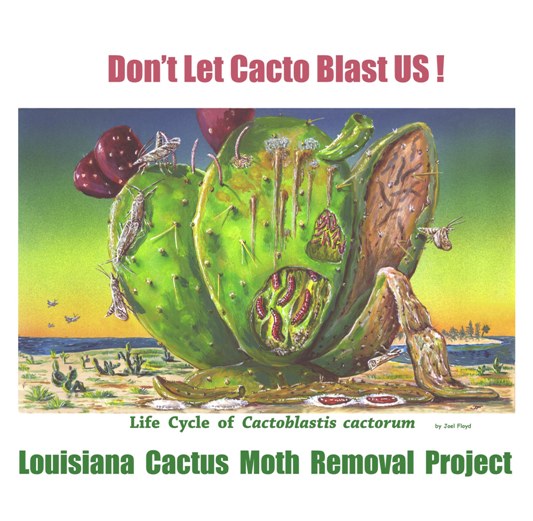 |
| A beautiful drawing of an ugly problem |
Here’s another great illustration that was sent to me. Joel Floyd, with USDA-APHIS, designed this for use on a T-shirt for the Cactoblastis program. If you know about this moth, it has been used as a biocontrol for invasive prickly pear in parts of the world, but has spread to the southeast United States and is attacking out native prickly pear species. Aphis has been leading the charge on the management of this insect, including coming up with great T-shirt designs.
Garlic Mustard Wine
h/t Troy Evans
 |
| Mmmm, tasty |
Yes, you read that correctly, Garlic Mustard wine. I can think of few plants less appropriate to make wine from than Garlic Mustard. Seriously, maybe poison ivy or jimsonweed wine would be worse but it is debatable. I do however really like their slogan “Eliminating Invasive Plants one bottle at a time”. I think this bottle has remained firmly unopened for fear of what’s inside. If you’ve ever tried such a concoction, please let me know what it tasted like (and please do not offer to share it with me!). Just a quick note, if this posts gets back to the folks that actually produce this Garlic Mustard wine, my sincere apologies for disparaging your product but, honestly, you had it coming!
What was originally meant to be a 3-part series has now been expanded to at least four. This 'Mascot' edition has probably been my favorite one to make so far. I keep getting impressed with the creativity and talent on display with these slogans and illustrations and, best of all, they are all for a good cause - increasing awareness about invasive species. So, to all of you conservationists out there, I say keep up the good work and please do use your talents to bring some humor and entertainment into a field that is honestly often somewhat depressing.
Please do check out the other entries in this series on Play-off, Alliteration, and Rhyming and all of the FUN posts we've put up on this blog. I am predicting that this will not be the last post in this series, as new slogans and illustrations are being made every day. As always, if you see something that you think would be good to include, please send it to me at rivertoriver@gmail.com. To follow the Illinois ISAM news blog, 'like' us at www.facebook.com/illinoisisam.
Subscribe to:
Posts (Atom)
